
- News
- Sports News
- Cricket News
- In Dubai, Pakistan cricket finds its long-lost warmth
Trending
This story is from February 7, 2018
In Dubai, Pakistan cricket finds its long-lost warmth
Nine years ago, an unfortunate event snatched away International cricket from Pakistan. But in Dubai, their cricket has found a fresh lease of life.
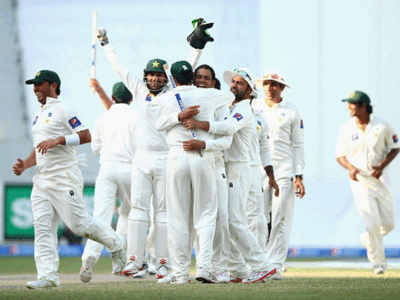
The Dubai International Stadium has been home to Pakistan cricket since 2009 (Getty Images)
Roughly three hours later, this happens: Hasan Ali to Jasprit Bumrah - OUT.

At that moment, while fireworks took off in every city of Pakistan, its native Salman Hanif, residing some 1800 miles away in Dubai, and the guy in-charge of the Dubai International Stadium for over almost nine years, did nothing extraordinary. Despite being persisted by his friends, Hanif decided to stay home and watch the match quietly with his family. He holds this win very dearly, as do the 193 million-odd people of Pakistan. But hang on; there's more to his joy than Pakistan beating India.
"Everything aside, I loved the fact that India and Pakistan finally played in the final of an ICC event for the first time in 10 years. The last time it happened was in 2007. So much has changed since. We don't really get to see these two teams play anymore, and it saddens me," Hanif says. "I think we have hosted all the teams here barring India. And I want to change that. I want to host India and Pakistan here in Dubai. That is my dream.
"I think this is the only cricketing rivalry which grabs attention worldwide. The level of cricket, the tension and excitement; everything is at its peak. That is something no two teams can match. We want to host both the teams at least once, whatever be the format it doesn't matter. This is what drives me."
Bold claims, one must say, because the ambitions of hosting an India-Pakistan match is equivalent to Podrick killing The Hound in the hit TV Show Game of Thrones. It is not happening; not anytime soon at least. More than a dream, it is something that Hanif considers a moral responsibility that he owes the
Pakistan cricket team and its fans in Dubai, for they have shows relentless support in these last nine years. September 24, 2008 is when the UAE was announced as the new home for Pakistan cricket, five months after that unfortunate terror attack at Lahore's Qaddafi Stadium. The wounds from the attack, which suspended nearly all international cricket in Pakistan, never quite healed, and they probably never will. But in the Emirates, and Dubai in particular, Pakistan cricket had found a second wind. Not only has it become their home away from home, the Dubai International Stadium has helped lift Pakistan from the depths of uncertainty but put them on an unprecedented path of success. In 11 Tests at the venue, Pakistan have lost only three.
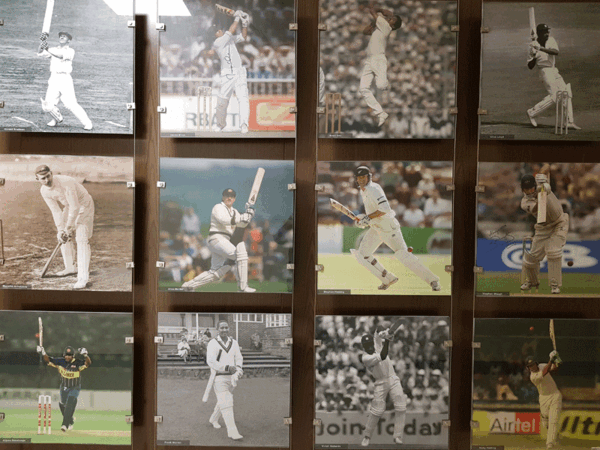
"When that unfortunate incident took place, the stadium was not even fully ready and it was handed over to us to manage and host events. Back in 2009, we were nearing completion but there was quite a bit of work remaining," Hanif tells TOI Sports. "When that incident took place, I think for Pakistan, it was a natural choice because of the close proximity and the number of Pakistanis who are based here and working here. There is a good sizeable Pakistan community here, plus it's just 1.5 hours away from Karachi via flight. So people can travel and all cricketing fans can come over here and watch the team play. It wasn't a difficult decision. Since they realised that it will be difficult to host cricket in Pakistan, I think we became a natural choice. Having three venues - Dubai, Abu Dhabi and Sharjah, it provided a good alternate option for Pakistan and their cricket."
Hanif, who came to Dubai in 2009, at a time when the entire Sports City was under construction and most of the area around was only a desert, adds that the transition was surprisingly easy. The fact that ICC's headquarters was based out of Dubai, just a kilometre away from the stadium, helped smooth out the process. Security concerns were plenty, as expected, but because of the good rapport between the Board and the Dubai Sports City, choosing Dubai as one of Pakistan's primary cricket homes was a foregone conclusion.
"ICC's only concerns were over the security, but once the officials were here and they conducted a proper check of the ground and all, it all eased out," Hanif says. "They have zero-tolerance when it comes to players' security. Plus, the relationship between Dubai and Pakistan has always been a healthy one. So I think whatever support and requirements had to be fulfilled as far as recognising Dubai Sports City as an international venue and to host Test matches and ODIs, we achieved all that without muss hassle and that's why Pakistan was able to host immediately after that incident. We hosted the Pakistan-Australia ODI series in April-May 2009, and never looked back,"
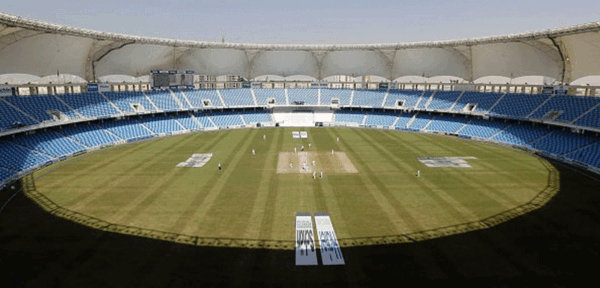
Indeed. In nine years, Pakistan and the UAE have blossomed into a romantic story. They have never lost a Test series here since making it their adopted home in 2010. Six teams have tried previously, and six teams have failed. They have stonewalled, barricaded, intimidated, and done whatever necessary to maintain their record straight. While many doubted whether their cricket would thrive with international cricket taken away from them, Pakistan have only progressed, onward and upward, in a way that they eventually got to the top of the Test rankings, albeit briefly. However, all of it did come at a cost.
"Developement of cricket back in the country took a severe hit since that attack," Hanif, who has also served with the Pakistan Cricket Board in the past, says. "I remember our days of watching cricket in Pakistan, how passionate we were and how we used to follow our teams to the stadium to watch them play. So all these elements went missing and it became difficult to keep the development going forward. Not just that but Pakistan suffered even in terms of revenues. It needs a lot of funding to develop cricket, plenty of which PCB had to fund. Hosting cricket here and not having any back home; it became very difficult for Pakistan to support the domestic cricket, especially the development and youth programs. I remember back in 2008-09, there were a lot of talent hunt programs taking place back in Pakistan, which again needed funds, and hence couldn't last long. Investment is required to keep bringing talent - the Under-16, Under-19 and when you are not able to play in your country all of that becomes difficult."
But Hanif still takes heart from how well Pakistan have performed here and slotted perfectly in Dubai's scheme of things. Everytime they come here to play, Hanif spots in the players a feeling of belongingness. And why wouldn't there be? It came at a time when Pakistan cricket could have run out of oxygen, once and for all. No home could have meant no cricket, no development, no money, no progress and for all we know, no PCB. To take those uncertainties and convert them into the kind of dominance they have shown in the Middle-East is rather commendable. In the last nine-odd years, there have been some memorable wins - the ones against England in 2012 - where Saeed Ajmal made the opposition dance to his tunes and claimed 7/55 - and against Australia in 2014 stand out. Add to that the individual glories of Ajmal, Misbah Ul Haq, Younus Khan, Yasir Shah and it makes Hanif a content man.
"When they beat Australia, it was different altogether. The players always come and greet me, but that day they invited me to their dressing room to celebrate. Trust me, I have been involved with Pakistan cricket for over a decade now and I have never seen that kind of celebration in my life. There were tears, hugs and what not. It has been incredible to see them rise the way they have," he says.
Hanif knows how difficult it must have been for Pakistan to acclimatise playing away in a different country. Will people accept them team after what happened in Lahore? Will there be enough participation from crowd? Or will other teams even visit the UAE to play against them? What happens if Pakistan never get to play in their country ever? Hanif mentions he has been asked these questions time and again by players.
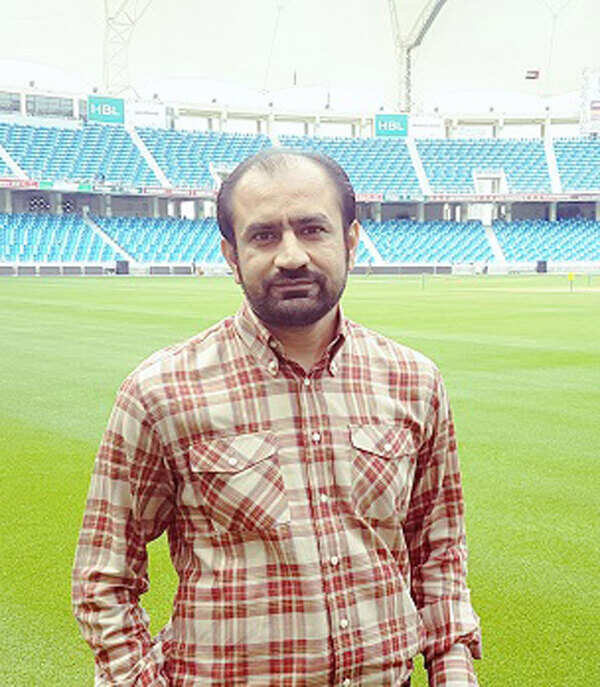
"What has helped them is the crowd participation. Even though it is a challenge to get them to come to the stadium on weekdays, weekends are packed. Like I said, a large part of Pakistani community resides here, so they are always keen to back the boys. No team can play without a home crowd and the players are always thankful to the crowd that shows up for their support, regardless of the number," he says. "The best event we hosted here was probably the IPL in 2014. The stadiums were packed. Then the last year's PSL too was a success. The opening ceremonies and the last few play-off matches were closely conducted."
On being asked whether there is a special bond he shares with the players, Hanif is kind of overwhelmed. He says that although his equation is almost the same with every player, he revels in the feeling of 'being known' in their team. As a fan and a Pakistan cricketing staff, he too was severely jolted by the attack of 2008 and what followed subsequently. And it is that same feeling because of which over the years, the two have formed a comfortable rapport.
Hanif does whatever he can to ensure the comfort of the players. However, there is one player Hanif looks forward to the most, and that is India's second wrecker in chief during the Champions Trophy after Fakhar Zaman. The man who removed India's top three - Shikhar Dhawan, Rohit Sharma and Virat Kohli - Mohammad Amir. Hanif's association with Amir goes back during the pacer's Under-19 days where the two worked in close quarters.
"The one thing I wish would have never happened was the whole match-fixing scandal regarding Amir because I have worked very closely with Amir, when he was part of Under-19. We did a lot of work with him, developing him as a cricketer, individual and a human being. In a way we groomed him. So when that happened, it was a pretty heavy dent, one that was difficult to absorb. But he has come back exceptionally well. In the Champions Trophy, when he bowled the first ball, I think that set the tone," he says. "I was also impressed by Kohli for the kind of sportsman spirit he showed after the match. Watching him during the post-match conference, laughing with our guys and sharing jokes and stuff, it changed my perception of him."
Pakistan may have taken its biggest step yet towards full restoration of cricket at home by staging the first of three Twenty20 internationals against the World XI last September, but it is just the beginning of the process. It may take at least another three years before cricket returns to Pakistan entirely, and that is a day Hanif is not looking forward to.
"Honestly, when that time comes, I will be torn between Dubai and Pakistan. I want cricket to return to Pakistan but that will take away from the people here something they have embraced with open arms," Hanif says. "But until then, we will ensure that Pakistan continue to feel loved here."
(The correspondent's trip to Dubai was paid for by the Dubai Tour)
End of Article
FOLLOW US ON SOCIAL MEDIA


Photostories

Top Sports News
TOP TRENDING
Popular Categories
Hot on the Web
Top Trends
Hurricane MiltonRatan Tata NewsNew UPI Transaction LimitRatan Tata DiesPM ModiRafael NadalShantanu NaiduTom BradyStock Market TodayNarayana MurthyEngland Cricket Team New RecordRatan Tata Inspiring QuotesManagement Colleges of IndiaTop Medical Colleges of IndiaTop Engineering Colleges of IndiaTop Pharmacy Colleges of IndiaLive Cricket Score
Trending Topics
Diwali WishesBigg Boss Tamil 8 Contestants ListDussehra WishesVettaiyan Twitter ReviewSanjay Leela BhansaliVettaiyan ReviewSalman KhanDevara CollectionBigg Boss 18Deepika PadukoneShraddha KapoorRatan Tata Passed AwayColdplayVettaiyan Movie ReviewSwatantrya Veer SavarkarDussehra 2024Watch NFL Live StreamDress To ImpressRatan Tata DeathWordle Answer
Living and entertainment
Latest News
How Chennai Night Race swerved past challenges to zoom toward a brighter motorsports futureAll-Star Tower Defense (ASTD) Codes October 2024Ranveer Singh: I have a man crush on Tiger ShroffWho is Noel Tata? Meet Ratan Tata’s half-brother, who could be successor at Tata TrustsHow to make Ginger Turmeric Shots for seasonal changeWhen Amitabh Bachchan slept on Marine Drive with rats as neighbours: I didn’t have a place to stayEthel Kennedy, widow of Senator Robert F Kennedy Sr suffers stroke in sleep, hospitalised'Stree 2' hits OTT after record-breaking box office success: Here’s where to watch!Da Hood Codes October 2024: Unlock new weapons to elevate your gameplayTriple centurion Harry Brook happy to break Dad's club record'Thalapathy 69': Here's how much Vijay will be earning in his last film!Happy Dussehra 2024: Top 50 Wishes, Messages, and Quotes to Share with Your Loved OnesHow The Tarot Suit Can Be Associated With The Elements'You're drunk': Britons stunned by BBC app's shocking 18,995 mph wind forecast!Hanging Lights For Living Room: Transform and Illuminate Your SpaceArko: The reach of Bollywood is greater than single albumsExclusive- Iss Ishq Ka Rab Rakha fame Shalini Kapoor Sagar on celebrating Navratri festivities says, "We will be shooting the Durga Puja track soon"Leaders of 24 countries, UN chief to attend BRICS summit: Kremlin
Copyright © 2024 Bennett, Coleman & Co. Ltd. All rights reserved. For reprint rights: Times Syndication Service